The Science of Muscle Recovery & DOMS
Delayed-onset muscle soreness, or DOMS, is the stiff, tender feeling that shows up 12 to 48 hours after unfamiliar or intense exercise, caused by microscopic tears in muscle fibers and the inflammatory response that follows as the body repairs them.
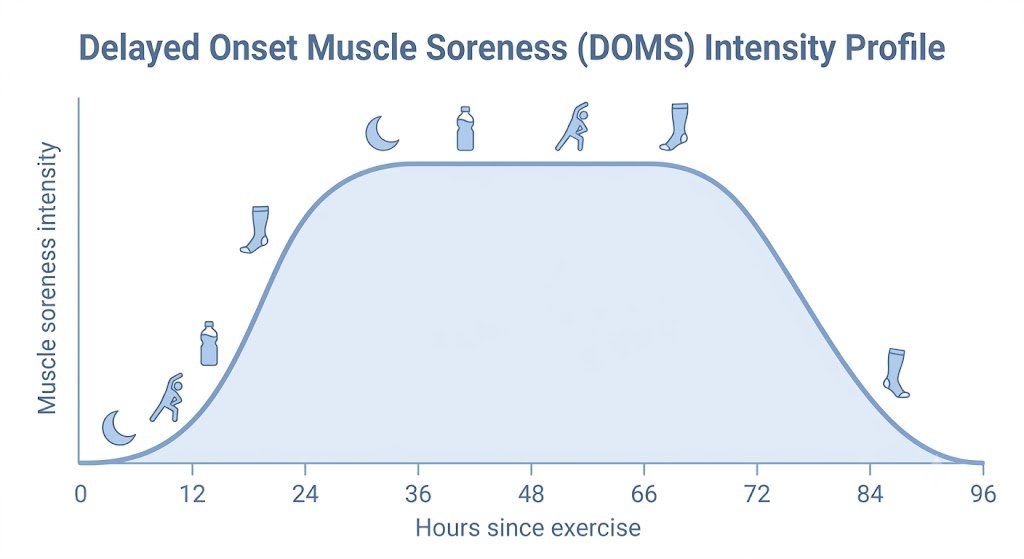
DOMS is different from the sharp, immediate pain of an injury. It builds gradually, peaks around 24–72 hours after activity, and fades on its own within about a week as the muscle repairs and adapts — a process exercise scientists call the "repeated bout effect," where the same activity causes less soreness the next time.
What actually happens inside a sore muscle?
Unfamiliar or eccentric exercise — movements where a muscle lengthens under load, like the downward phase of a squat — creates microscopic disruptions in muscle fibers, which trigger local inflammation, fluid shifts, and sensitized nerve endings that register as soreness.
This process is sometimes called exercise-induced muscle damage (EIMD). It's a normal, expected part of adaptation, not a sign that something has gone wrong — the same mechanism that causes the ache is part of how muscle becomes stronger and more resilient over time.
What does research say actually helps with DOMS?
Research on DOMS interventions — including compression, massage, light activity, and cold exposure — generally finds modest, inconsistent benefits rather than a single reliable cure, with the most consistent supported strategies being gradual training progression and light active recovery.
Specifically for compression: multiple randomized trials and at least one large 2024 systematic review found that intermittent pneumatic compression tends to reduce how sore muscles feel — a trivial-to-moderate effect — without reliably restoring strength or range of motion faster than rest alone. Some individual trials found no significant difference at all in objective muscle-function measures. This is a meaningful nuance: compression appears to help comfort and perceived recovery more clearly than it "cures" the underlying muscle damage.
Is soreness the same thing as muscle damage severity?
No — soreness and true muscle damage often don't move together, since a person can feel very sore with only mild tissue disruption, or feel only mild soreness after more significant microtrauma, which is why researchers measure both subjective soreness scores and objective markers like creatine kinase separately.
This is a common misconception worth correcting: "no pain, no gain" oversimplifies a more nuanced relationship. Chasing maximum soreness isn't a useful training goal, and reducing soreness with a recovery tool doesn't necessarily mean the muscle has fully repaired.
Where does a device like the Air-C Compression Massager fit in?
A wearable compression device fits into the "comfort and perceived-recovery" category of DOMS management — useful for feeling less stiff and tight after activity — rather than the category of interventions proven to accelerate the underlying biological repair process.
Used alongside the basics that have the strongest evidence — adequate sleep, gradual training progression, and staying active with light movement — a tool like the Air-C Compression Massager can reasonably be positioned as a comfort-focused addition to a recovery routine, not a replacement for those fundamentals.
Key takeaways
DOMS is a normal, temporary response to unfamiliar or intense exercise driven by microscopic muscle fiber disruption and inflammation, and while compression therapy shows a modest, well-documented benefit for perceived soreness, sleep, gradual training, and light movement remain the best-supported recovery habits.
Selected sources
- Maia, F. et al. "Effects of lower-limb intermittent pneumatic compression on sports recovery: A systematic review and meta-analysis." Biology of Sport, 2024. Via PMC.
- "The efficacy of intermittent pneumatic compression and negative pressure therapy on muscle function, soreness and serum indices of muscle damage: a randomized controlled trial." BMC Sports Science, Medicine and Rehabilitation. Via Springer Link.