How Air Compression Therapy Works
Air compression therapy, technically called intermittent pneumatic compression (IPC), works by inflating a series of air chambers around a limb in sequence, then releasing them, so pressure moves along the limb like a wave instead of clamping down all at once.
IPC has been used clinically for decades — most recognizably in the inflatable leg sleeves given to hospital patients to reduce blood clot risk after surgery — and more recently in consumer sports-recovery devices such as recovery boots and compression wraps like the Air-C Compression Massager. The underlying mechanism is the same in both settings; what differs is the pressure range, session length, and intended use.
What is inside a pneumatic compression sleeve?
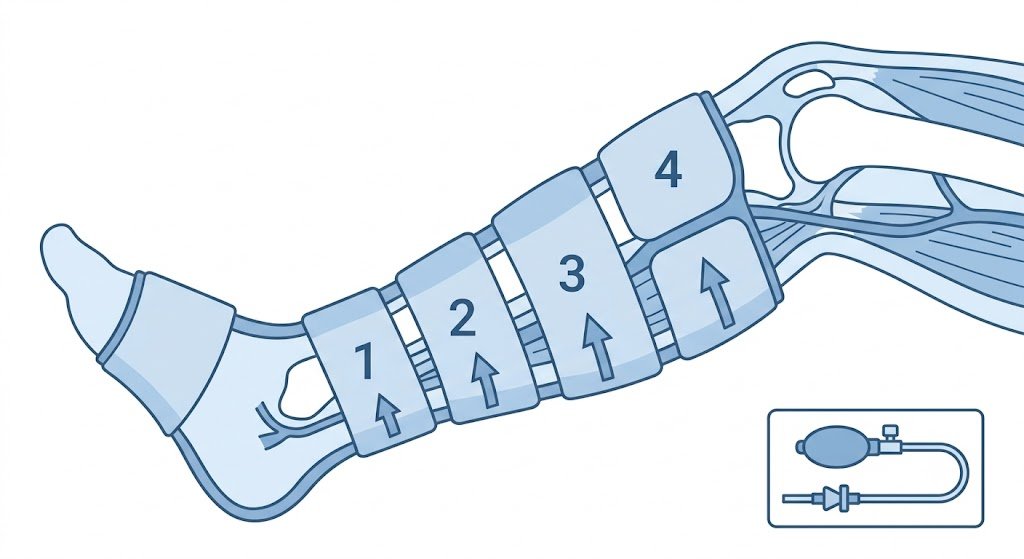
A pneumatic compression sleeve contains multiple sealed air chambers, a small electric pump, a set of directional valves, and a controller that times how long each chamber stays inflated before the next one takes over.
The chambers are usually arranged from the far end of the limb toward the body — for example, ankle to knee on a leg sleeve. This directionality is intentional: inflating the lowest chamber first and moving upward mirrors the natural direction that blood and lymph fluid travel back toward the heart, which is discussed further in our article on circulation and lymphatic drainage.
How does the compression sequence actually feel?
A typical IPC cycle feels like a firm, rolling squeeze that builds for a few seconds, holds briefly, then releases before the next segment inflates, repeating for the length of the session — usually 15 to 30 minutes.
Pressure is usually measured in millimeters of mercury (mmHg), the same unit used for blood pressure. Clinical DVT-prevention sleeves often run in a moderate range, while consumer recovery devices typically offer adjustable settings so users can choose a lighter or firmer sequence based on comfort and the area being treated.
What is the physiological theory behind compression therapy?
The leading physiological theory is that rhythmic external pressure helps move fluid through veins and lymphatic vessels back toward the torso, mechanically assisting a process the body normally handles through muscle contraction and one-way valves in the vessels.
When you walk, your calf muscles act like a pump, squeezing the deep veins in your legs with every step — sometimes called the "calf muscle pump." Sitting or standing still for long periods reduces this natural pumping action, which is part of why legs can feel heavy or swollen after a long flight or a day on your feet. External pneumatic compression is thought to substitute, in part, for that muscle-pump action.
Research bodies such as the National Institutes of Health note that mechanical compression devices are an established option in circulation-support and post-surgical care, separate from their newer, more limited evidence base in sports recovery. See the National Center for Biotechnology Information for further clinical literature.
Does research support air compression for muscle recovery specifically?
Systematic reviews on intermittent pneumatic compression for post-exercise recovery generally report a trivial-to-small benefit for muscle function and a trivial-to-moderate reduction in perceived soreness, with highly variable results on blood markers of muscle damage — meaning the evidence leans modestly positive rather than dramatic.
A 2024 systematic review and meta-analysis published in Biology of Sport, pooling 17 studies and roughly 300 participants, reported exactly this pattern: small improvements in how sore muscles felt, with less consistent effects on objective damage markers. Multiple randomized trials on exercise-induced muscle damage have reached a similar conclusion — IPC may help people feel less sore, even when strength and range-of-motion measurements don't move as much. That distinction matters: a device like this is well supported as a comfort and perceived-recovery tool, and should not be marketed as a guaranteed performance enhancer.
How does heat interact with the compression mechanism?
Heat causes local blood vessels to dilate (vasodilation), which increases blood flow to the area and can make surrounding soft tissue more pliable — a physiological effect that complements, rather than duplicates, the mechanical squeeze-and-release action of pneumatic compression.
This is why many modern compression wraps, including the Air-C Compression Massager's mechanism, add an adjustable heat layer: the two effects work through different pathways (mechanical fluid movement versus vascular dilation) rather than one simply amplifying the other.
Key takeaways
Air compression therapy uses sequential inflation of chambered air sleeves to create a wave-like squeeze that supports natural venous and lymphatic return, with a modest, well-documented evidence base for reducing perceived post-exercise soreness rather than dramatically altering measurable recovery markers.
Selected sources
- Maia, F. et al. "Effects of lower-limb intermittent pneumatic compression on sports recovery: A systematic review and meta-analysis." Biology of Sport, 2024. Via PubMed.
- Journal of Sport Rehabilitation, "The Effects of Intermittent Pneumatic Compression on the Reduction of Exercise-Induced Muscle Damage in Endurance Athletes." Via Human Kinetics Journals.
- National Center for Biotechnology Information — general clinical literature on pneumatic compression devices, ncbi.nlm.nih.gov.