Circulation & Lymphatic Drainage, Explained Simply
Circulation is the ongoing movement of blood through the body, while the lymphatic system is a separate, parallel network of vessels that collects excess fluid, proteins, and waste from tissues and drains them back into the bloodstream — both rely partly on surrounding muscle movement to keep fluid flowing.
How does blood get back to the heart from your legs?
Blood travels away from the heart through arteries under pressure from each heartbeat, but the return trip through veins relies on one-way valves and the squeezing action of nearby muscles — most importantly the calf muscles — to push blood upward against gravity.
This is why standing or sitting still for long periods can make legs feel heavy: without regular muscle contraction, venous return slows down and fluid can pool in the lower limbs. Walking, stretching, or elevating the legs are the body's normal ways of restarting that flow.
What does the lymphatic system actually do?
The lymphatic system is a network of thin vessels and lymph nodes that collects interstitial fluid — the fluid that leaks out of capillaries into surrounding tissue — filters it through lymph nodes, and returns it to the bloodstream, playing a central role in fluid balance and immune defense.
Unlike the circulatory system, the lymphatic system has no central pump like the heart. Lymph fluid moves through a combination of one-way valves, gentle vessel contractions, and — again — surrounding muscle and tissue movement, which is part of why manual lymphatic drainage massage and compression garments are used clinically to support this system when it's not working efficiently on its own (a condition called lymphedema).
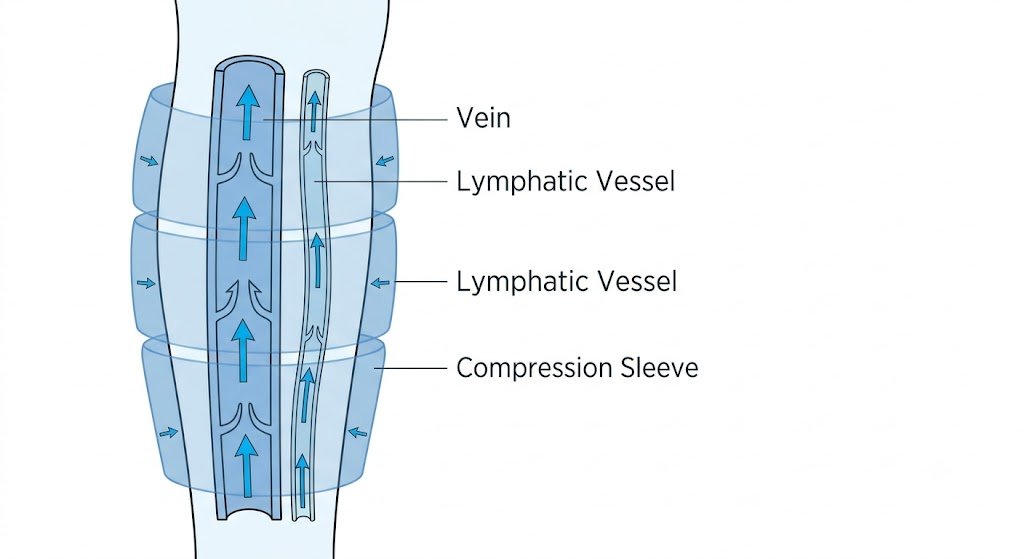
Why does compression follow a specific direction (ankle to knee, not the reverse)?
Compression sleeves inflate from the far end of the limb toward the body because that direction matches the natural path blood and lymph fluid take back toward the heart, so pressure applied in that sequence works with the body's existing plumbing rather than against it.
This is the same principle referenced in our companion piece on the mechanism of air compression therapy: the order in which chambers inflate isn't arbitrary, it mirrors venous and lymphatic anatomy.
Is compression the same thing as a lymphatic drainage massage?
No — manual lymphatic drainage is a specific, light-touch massage technique performed by trained therapists, typically for diagnosed conditions like lymphedema, while pneumatic compression devices apply generalized, sequential pressure and are more commonly used for general circulation comfort and post-activity muscle relief rather than as clinical lymphedema treatment.
Anyone with diagnosed lymphedema, a blood clot, or another circulatory condition should be evaluated and guided by a healthcare provider rather than relying on a consumer wellness device — a point covered further in the site disclaimer and the safety section of the main product page.
Key takeaways
Circulation and lymphatic drainage both depend partly on surrounding muscle activity to move fluid back toward the heart, which is the physiological basis for why sequential, ankle-to-knee compression is used in both clinical devices and consumer products, even though a wellness device is not the same as clinical lymphedema treatment.
Selected sources
- General physiology references on venous return and lymphatic system function, National Center for Biotechnology Information, ncbi.nlm.nih.gov.